Have you ever noticed how a change in your surroundings can instantly shift your mood? You walk into a room with soft lighting and calming colors, and suddenly your shoulders relax. You sit in a poorly lit, cluttered office, and within an hour, your anxiety creeps up.
This isn’t a coincidence. Interior design is one of the most underestimated wellness tools available to us.
For over a decade, I’ve witnessed how thoughtful design can transform not just the way a space looks but how people feel within it. Design shapes our mood, sharpens our focus, and supports our well-being in ways that are subtle yet profoundly powerful. In this article, I’ll share how lighting, materials, and spatial organization directly influence your daily emotional state—and how you can use these principles to create a personal sanctuary.
The Hidden Power of Your Environment
Most of us spend 80–90% of our time indoors. Yet we rarely pause to consider how our surroundings affect our mental health, energy levels, and productivity.
The psychology is clear: Our brains are incredibly responsive to environmental cues. The colors we see, the textures we touch, the quality of light hitting our eyes—all of these send signals to our nervous system.
When I design a space, I’m not decorating for decoration’s sake. I’m crafting an environment that supports people. That means understanding:
- How light impacts your circadian rhythm and energy
- Which materials create a sense of calm versus stimulation
- How spatial layout either promotes or hinders your daily flow
- Why certain color combinations feel harmonious while others feel chaotic
This is where wellness-centered design begins: with intention, not impulse.
Three Pillars of Wellness Design
1. Lighting: The Foundation of Your Mood
Light is arguably the most powerful tool in design because it directly affects your nervous system.
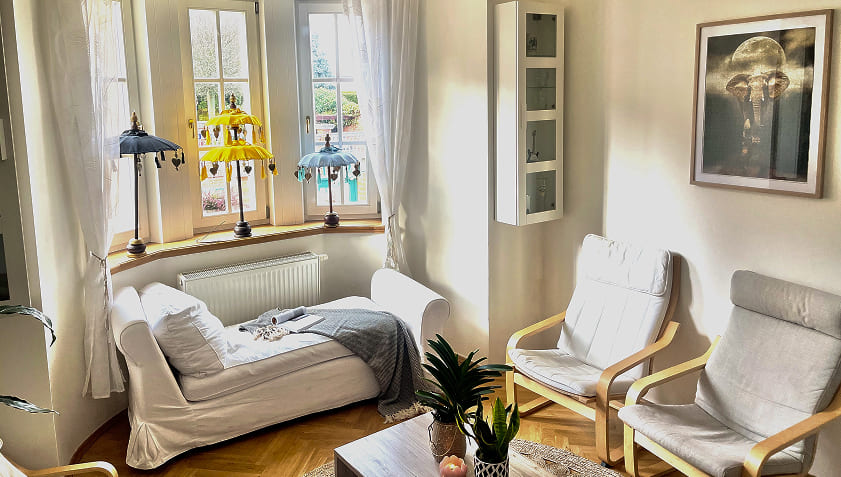
Natural light is ideal—it regulates your sleep-wake cycle and boosts serotonin levels. But many of us work in spaces with poor windows or limited daylight. This is where intentional artificial lighting becomes crucial.
I always recommend a layered lighting approach:
- Ambient lighting: Soft, diffuse light that fills the entire room without harsh shadows. This is your baseline—the “calm” setting.
- Task lighting: Focused light for work or reading. Warmer color temperatures (2700K–3000K) are gentler on the eyes than cool white (5000K+).
- Accent lighting: Used strategically to highlight architectural features or create visual interest without overpowering the space.
Pro tip: Avoid overhead lighting as your only light source. It’s often too bright and creates an institutional feel. Instead, use table lamps, wall sconces, or pendant lights positioned at different heights.
2. Materials & Textures: The Tactile Experience
The materials you choose affect both how a space looks and how it feels to inhabit.
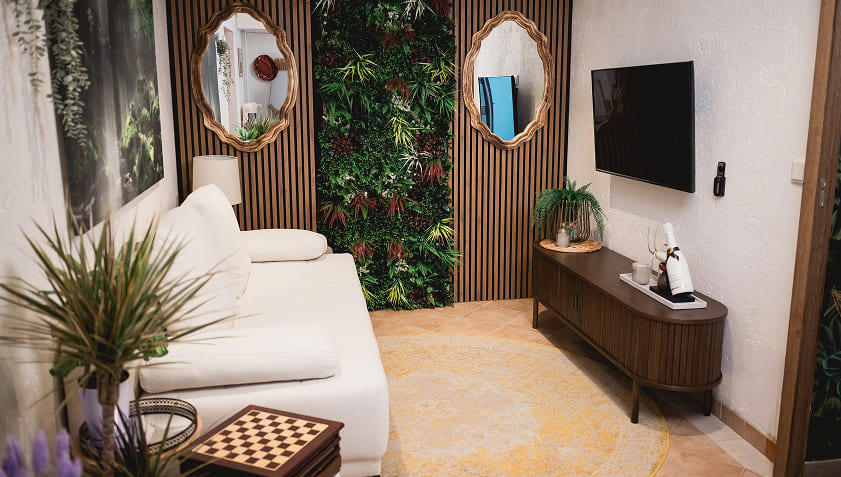
Soft, natural materials—wood, linen, cotton, wool—create a sense of warmth and safety. They’re psychologically grounding. When you touch a natural fiber or see the grain of real wood, your brain registers authenticity and craftsmanship, which translates to a feeling of care.
In contrast, hard plastics or synthetic materials can feel cold and disconnected, even if they’re practical.
In my designs, I emphasize:
- Natural textiles for soft furnishings (curtains, upholstery, rugs)
- Sustainable wood or stone for structural elements
- Plants and organic elements to bring life and softness into the space
- Quality over quantity—fewer, well-chosen pieces that you genuinely love
This approach doesn’t mean luxury or expense. It means intentionality. A well-chosen linen curtain from a thoughtful supplier can create more wellness than a room full of trend-driven fast furniture.
3. Spatial Organization: The Freedom to Breathe
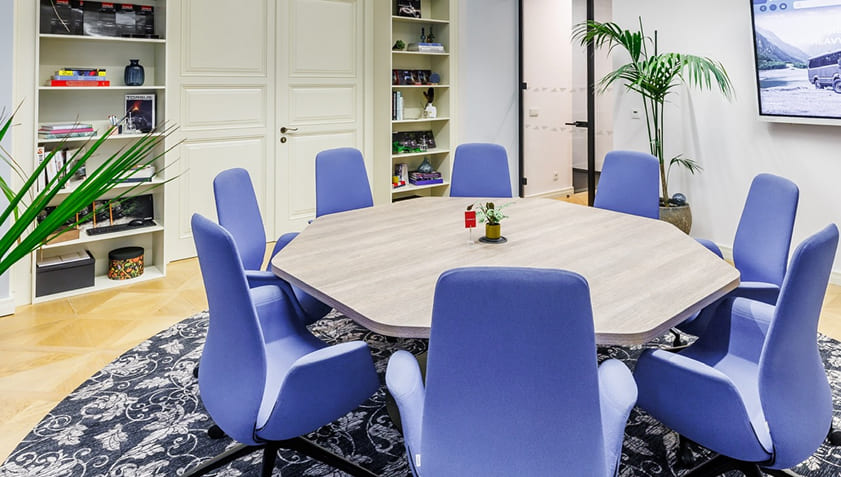
Clutter affects your mental state more than you might realize. A disorganized room creates cognitive load—your brain is constantly processing visual noise, which drains focus and increases stress.
Smart organization isn’t about minimalism; it’s about function meeting intention.
I design storage and spatial flow so that:
- Everything has a purpose and a place
- Daily routines flow naturally from one zone to another
- Visual clutter is minimized without sacrificing warmth or personality
- Negative space (empty space) is as important as filled space
A well-organized room says to your nervous system: “You are safe here. You know where things are. You can relax.”
Practical Steps to Start Today
You don’t need a full design overhaul to begin using design as a wellness tool. Here are three immediate actions:
Audit Your Lighting
- Spend one week noticing how you feel in each room at different times of day
- Identify areas that feel too bright, too dim, or cold
- Add one warm-toned lamp to a space where you spend significant time
Choose One Natural Material Upgrade
- Replace one synthetic item with a natural alternative (a wool cushion, a linen throw, or a potted plant)
- Notice how your sensory experience changes
Organize One Zone
- Pick one area in your home or office that drains you when you look at it
- Spend one hour creating a simple organizational system
- Observe how your mood shifts once clutter is resolved
Why This Matters for Your Home, Office, and Lifestyle
Whether you’re designing a cozy bedroom, a productive home office, or a welcoming living space, the principles remain the same: thoughtful design is self-care.
Your environment is not a luxury—it’s a foundation. Just as you wouldn’t ignore your physical health, your mental and emotional health deserves an environment that supports it.
Frequently Asked Questions
Q: Can wellness design work in small spaces?
A: Absolutely. In fact, small spaces benefit most from thoughtful organization and intentional lighting. When every element serves a purpose and you can navigate the space without friction, even a compact area becomes a sanctuary.
Q: Does wellness-centered design have to be expensive?
A: No. High cost doesn’t equal high impact. What matters is intentionality—choosing materials and light sources that serve your well-being, even if it’s a gradual process. Many of my clients start with one room and expand over time.
Q: How long does it take to feel the benefits of a redesigned space?
A: Most people notice a shift within the first week. You’ll feel less stressed when you walk in, sleep better in a well-lit bedroom, or focus more easily in an organized office. The deeper benefits (improved mood, renewed energy) often develop over months as your nervous system adjusts to the supportive environment.
Q: Can I apply these principles to a rental space?
A: Yes. Lighting, textiles, and smart organization don’t require permanent changes. You can layer in plants, add warm lighting fixtures, bring in natural textiles, and organize without damaging walls. Many of my clients live in rentals and create beautiful sanctuaries within those constraints.
Design, at its heart, is a conversation between you and your space.
When approached with care and intention, it becomes one of the most accessible wellness tools available.
If you’re ready to transform how you feel in your surroundings—whether it’s a single room or your entire home—I’d love to collaborate with you.
Every project is a chance to create a space that doesn’t just look beautiful but feels like home.
Ready to create a space that supports your well-being?
Book your free consultation with me today. Let’s talk about your space, your needs, and how thoughtful design can transform your daily life.
I’m here to listen, understand, and guide you toward interiors that truly serve you.